Digestive System

What Is the Digestive System?
Food is our fuel, and its nutrients give our bodies' cells the energy and substances they need to work. But before food can do that, it must be digested into small pieces the body can absorb and use.
The first step in the digestive process happens before we even taste food. Just by smelling that homemade apple pie or thinking about how delicious that ripe tomato is going to be, you start salivating — and the digestive process begins in preparation for that first bite.
Almost all animals have a tube-type digestive system in which food:
- enters the mouth
- passes through a long tube
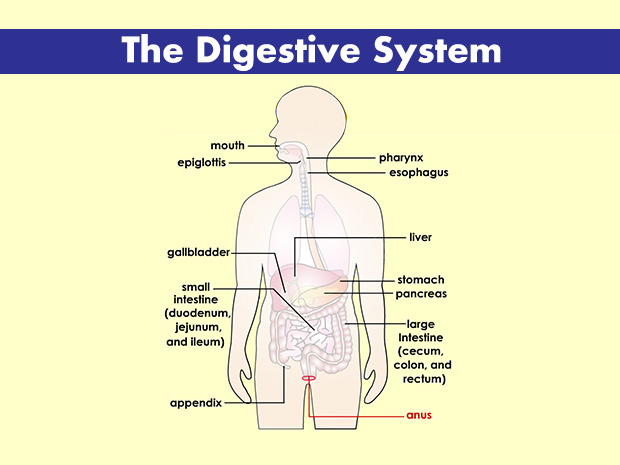
- exits the body as feces (poop) through the anus
Along the way, food is broken down into tiny molecules so that the body can absorb nutrients it needs:
- Protein must be broken down into amino acids.
- Starches break down into simple sugars.
- Fats break down into into fatty acids and glycerol.
The waste parts of food that the body can't use are what leave the body as feces.
Watch & Learn Together
Kids love our Chloe & Nurb videos about how the body works! Learn all about the digestive system and what it does.
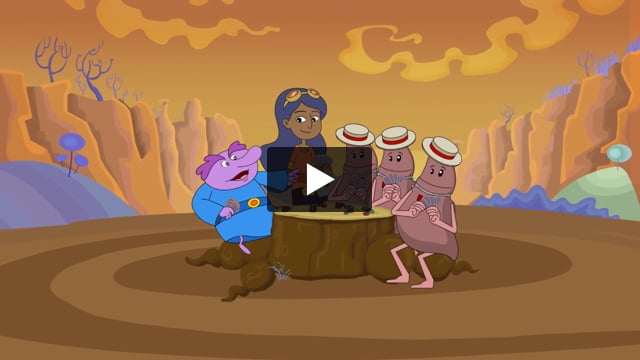
How the Digestive System Works
Watch this movie about your digestive system, the system that handles the food you eat.
Test Your Knowledge!
After watching, take this quiz to test your knowledge of the digestive system.
Which Organs Are Part of the Digestive System?
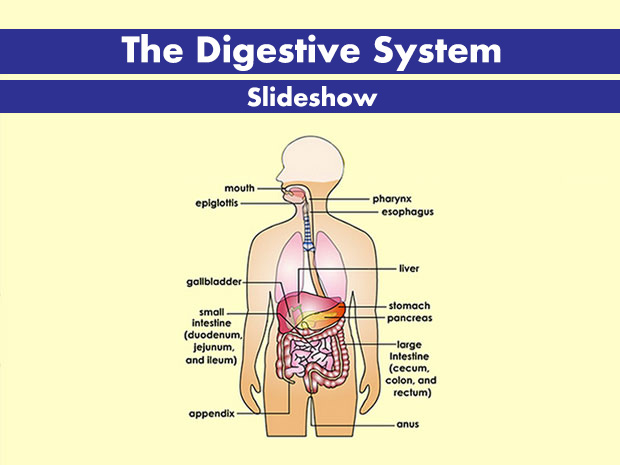
The digestive system is made up of the alimentary canal (also called the digestive tract) and other organs, such as the liver and pancreas. The alimentary canal is the long tube of organs — including the esophagus, stomach, and intestines — that runs from the mouth to the anus. An adult's digestive tract is about 30 feet (about 9 meters) long.
Mouth
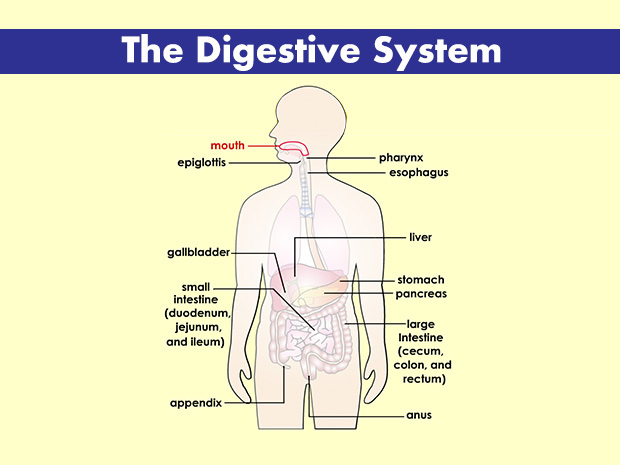
Digestion begins in the mouth, well before food reaches the stomach. When we see, smell, taste, or even imagine a tasty meal, our salivary glands in front of the ear, under the tongue, and near the lower jaw begin making saliva (spit).
As the teeth tear and chop the food, spit moistens it for easy swallowing. A digestive enzyme in saliva called amylase (AH-meh-lace) starts to break down some of the carbohydrates (starches and sugars) in the food even before it leaves the mouth.
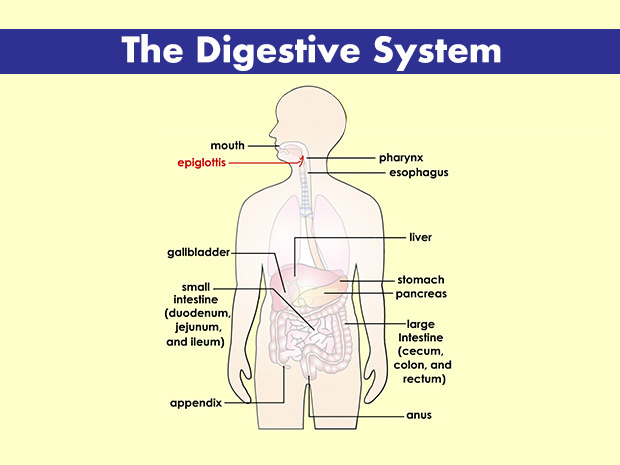
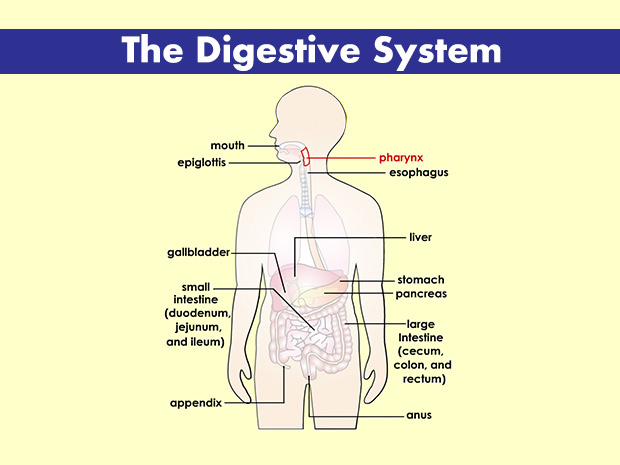
Swallowing, done by muscle movements in the tongue and mouth, moves the food into the throat, or pharynx (FAIR-inks). The pharynx is a passageway for food and air. A soft flap of tissue called the epiglottis (ep-ih-GLAH-tus) closes over the windpipe when we swallow to prevent choking.
Esophagus
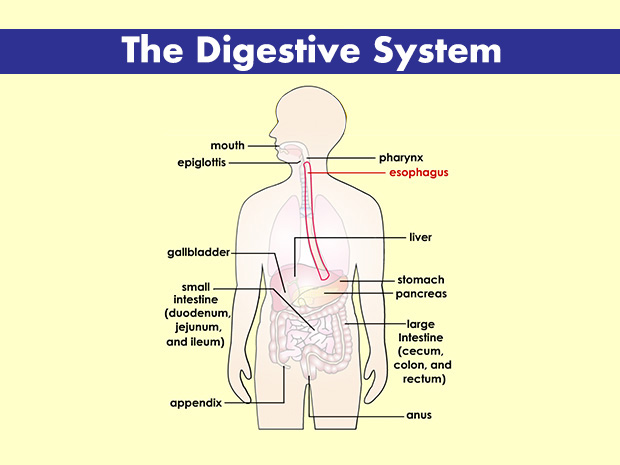
From the throat, food travels down a muscular tube in the chest called the esophagus (ih-SAH-fuh-gus). Waves of muscle contractions called peristalsis (per-uh-STALL-sus) force food down through the esophagus to the stomach. A person normally isn't aware of the movements of the esophagus, stomach, and intestine that take place as food passes through the digestive tract.
Stomach
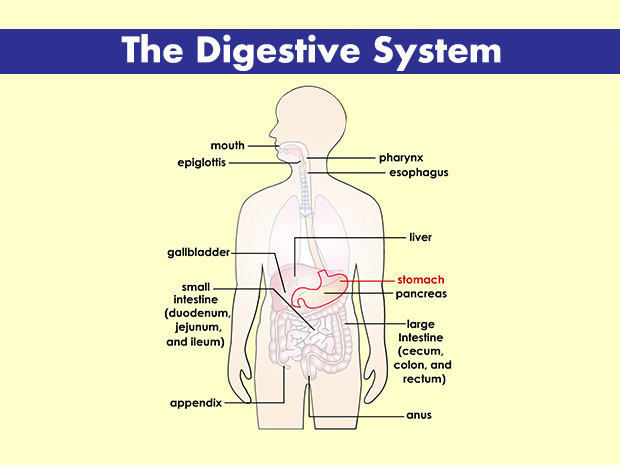
At the end of the esophagus, a muscular ring or valve called a sphincter (SFINK-ter) allows food to enter the stomach and then squeezes shut to keep food or fluid from flowing back up into the esophagus. The stomach muscles churn and mix the food with digestive juices that have acids and enzymes, breaking it into much smaller, digestible pieces. An acidic environment is needed for the digestion that takes place in the stomach.
By the time food is ready to leave the stomach, it has been processed into a thick liquid called chyme (kime). A walnut-sized muscular valve at the outlet of the stomach called the pylorus (pie-LOR-us) keeps chyme in the stomach until it reaches the right consistency to pass into the small intestine. Chyme is then squirted down into the small intestine, where digestion of food continues so the body can absorb the nutrients into the bloodstream.
Small Intestine
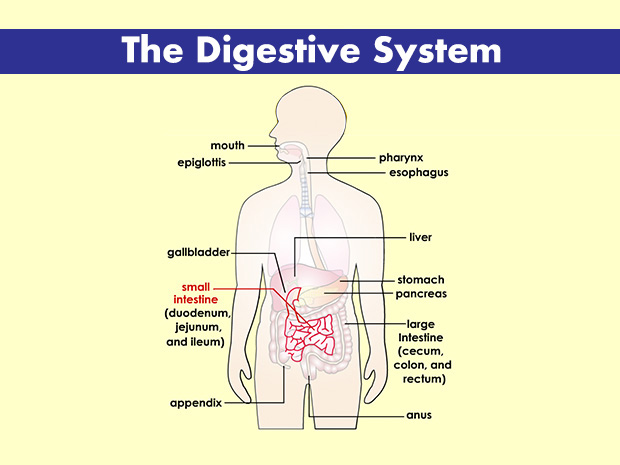
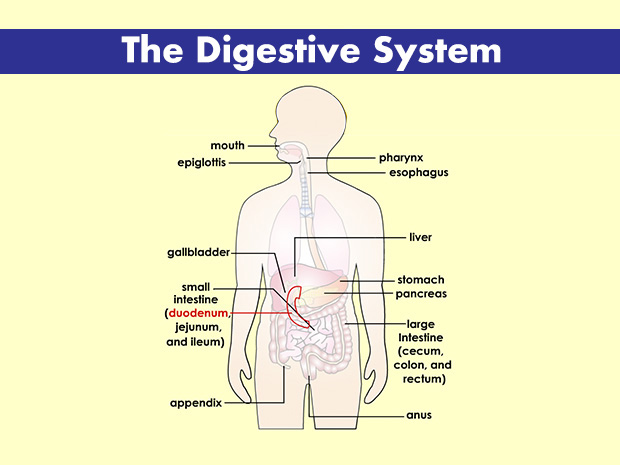
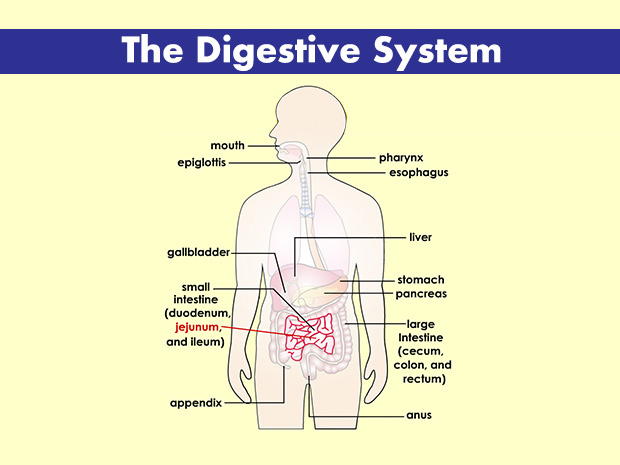
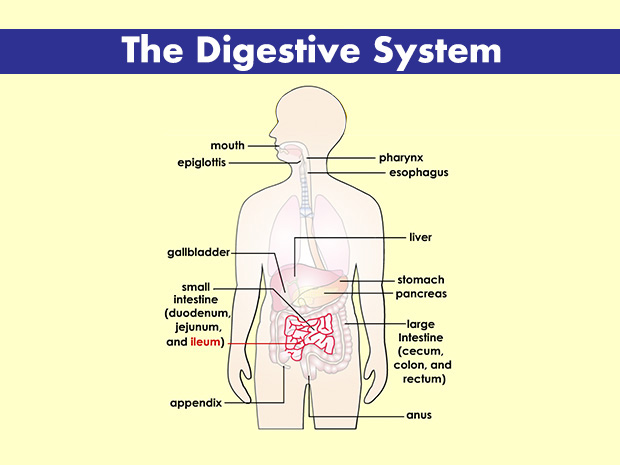
The small intestine is made up of three parts:
- duodenum (due-uh-DEE-num), the C-shaped first part
- jejunum (jih-JU-num), the coiled midsection
- ileum (IH-lee-um), the final section that leads into the large intestine
The inner wall of the small intestine is covered with millions of microscopic, finger-like projections called villi (VIH-lie). The villi are the vehicles through which nutrients can be absorbed into the blood. The blood then brings these nutrients to the rest of the body.
Liver, Gallbladder & Pancreas
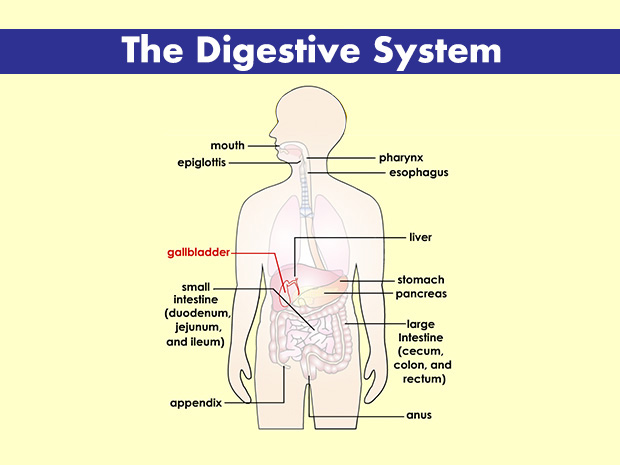
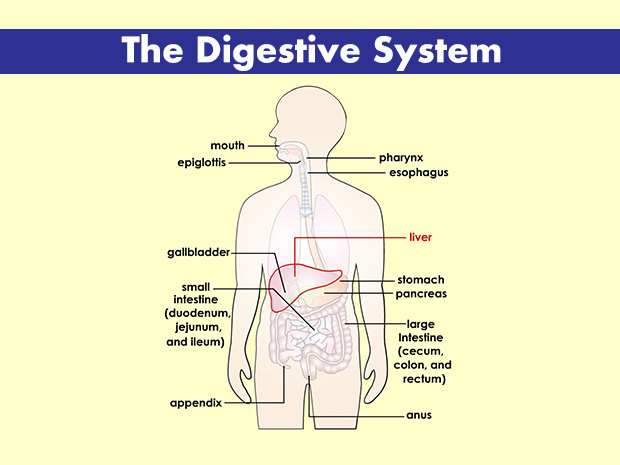
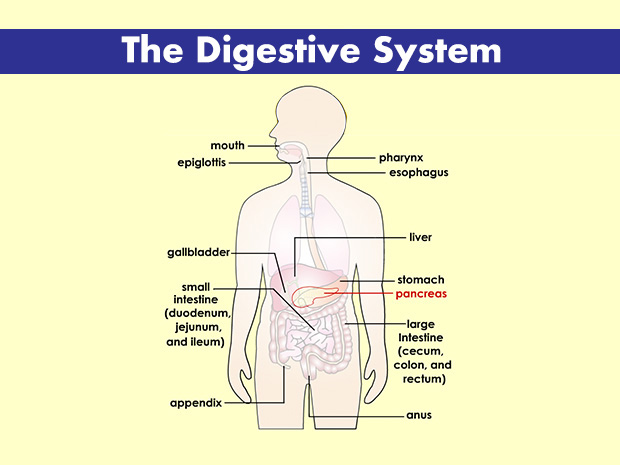
The liver (under the ribcage in the right upper part of the abdomen), the gallbladder (hidden just below the liver), and the pancreas (beneath the stomach) are not part of the alimentary canal, but these organs are essential to digestion.
The liver makes bile, which helps the body absorb fat. Bile is stored in the gallbladder until it is needed. The pancreas makes enzymes that help digest proteins, fats, and carbs. It also makes a substance that neutralizes stomach acid. These enzymes and bile travel through special pathways (called ducts) into the small intestine, where they help to break down food. The liver also helps process nutrients in the bloodstream.
Large Intestine
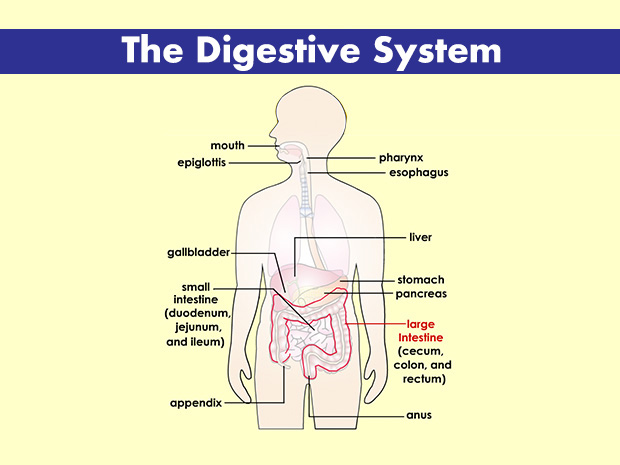
From the small intestine, undigested food (and some water) travels to the large intestine through a muscular ring or valve that prevents food from returning to the small intestine. By the time food reaches the large intestine, the work of absorbing nutrients is nearly finished.
The large intestine's main job is to remove water from the undigested matter and form solid waste (poop) to be excreted.
The large intestine has three parts.
Cecum
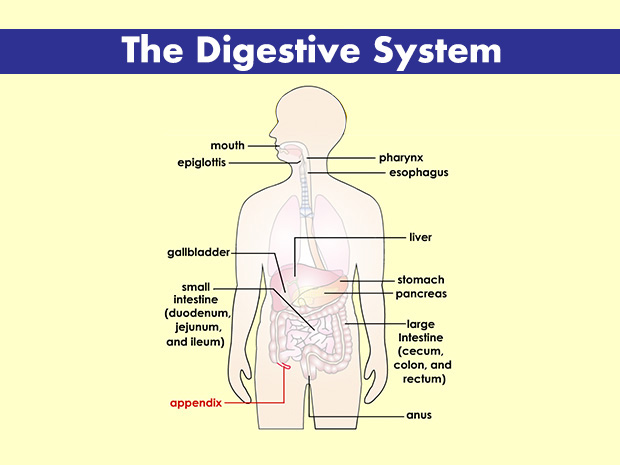
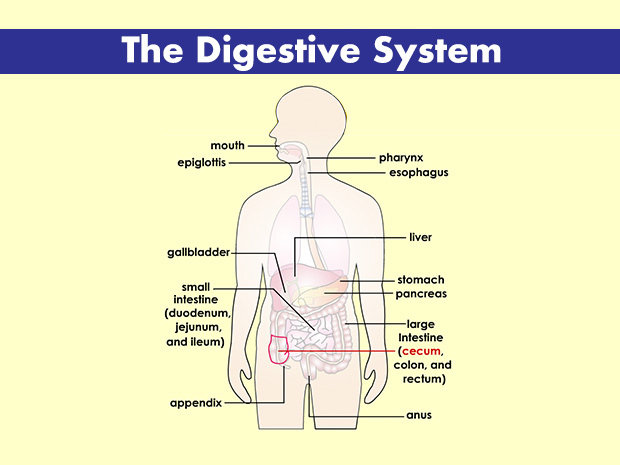
The cecum (SEE-kum) is the beginning of the large intestine. The appendix, a small, hollow, finger-like pouch, hangs at the end of the cecum. Scientists believe the appendix is left over from a previous time in human evolution. It no longer appears to be useful to the digestive process.
Colon
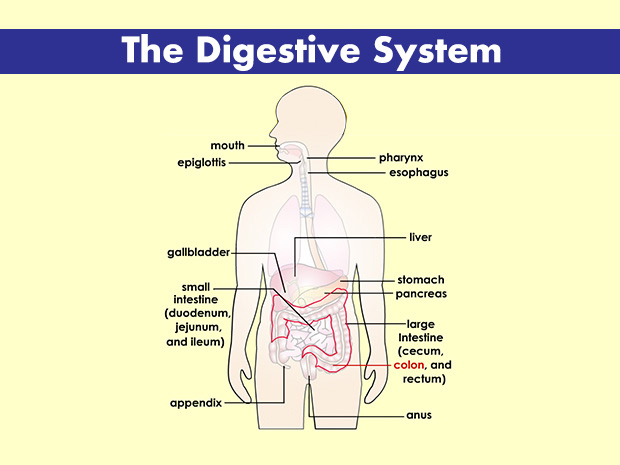
The colon extends from the cecum up the right side of the abdomen, across the upper abdomen, and then down the left side of the abdomen, finally connecting to the rectum.
The colon has three parts: the ascending colon and the transverse colon, which absorb fluids and salts; and the descending colon, which holds the resulting waste. Bacteria in the colon help to digest the remaining food products.
Rectum
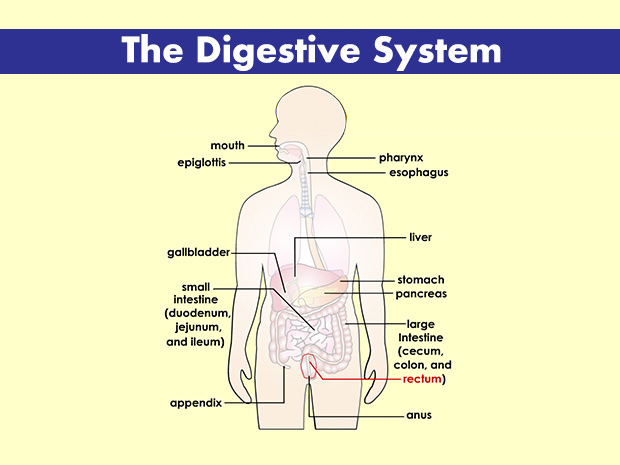
The rectum is where feces are stored until they leave the digestive system through the anus as a bowel movement.
It takes hours for our bodies to fully digest food.
 Note: All information is for educational purposes only. For specific medical advice,
diagnoses, and treatment, consult your doctor.
Note: All information is for educational purposes only. For specific medical advice,
diagnoses, and treatment, consult your doctor.
© 1995- The Nemours Foundation. KidsHealth® is a registered trademark of The Nemours Foundation. All rights reserved.
Images sourced by The Nemours Foundation and Getty Images.